Oritiq · Supply chain software
Selling a decision layer to people who already bought an ERP
Supply chain planning software whose hardest job was explaining why the system the buyer already owns is not enough.
The brief
What they came to us with
Oritiq is a supply chain decision intelligence platform that sits above a company's ERP, covering planning, procurement, production and distribution. It sells into manufacturers running real factories, in automotive, steel, pharma, textiles, FMCG, consumer durables, building materials, industrial equipment, renewables and defence. The buyer is a supply chain or operations leader at a company somewhere between ₹100 crore and ₹50,000 crore in revenue. That buyer has already spent heavily on an ERP, and usually on consultants to implement it.
What the audit found
What was broken
- Finding 01
The buyer already owns software that is supposed to do this
Every prospect has an ERP. Any pitch that sounds like a second ERP gets filed under 'we have that'. The site has to establish, early and without insulting anyone, that the ERP is the system of record and not the system of decisions.
- Finding 02
The pain is real but nobody names it the same way
Sales commits to numbers operations cannot execute. Production drifts from what procurement was told. Inventory is in shortage or excess. Everyone recognises the symptoms and almost nobody calls it 'decision intelligence', which is the category name.
- Finding 03
Credibility has to arrive before the feature list
Enterprise manufacturing does not buy planning software from a company it has not heard of on the strength of a product tour. The founding team's track record has to carry weight in the first screen, not in an About page nobody opens.
The approach
What we did
Strategy first, then design, copy and build moving together from the same plan.
- Strategy
Lead with the contradiction, not the category
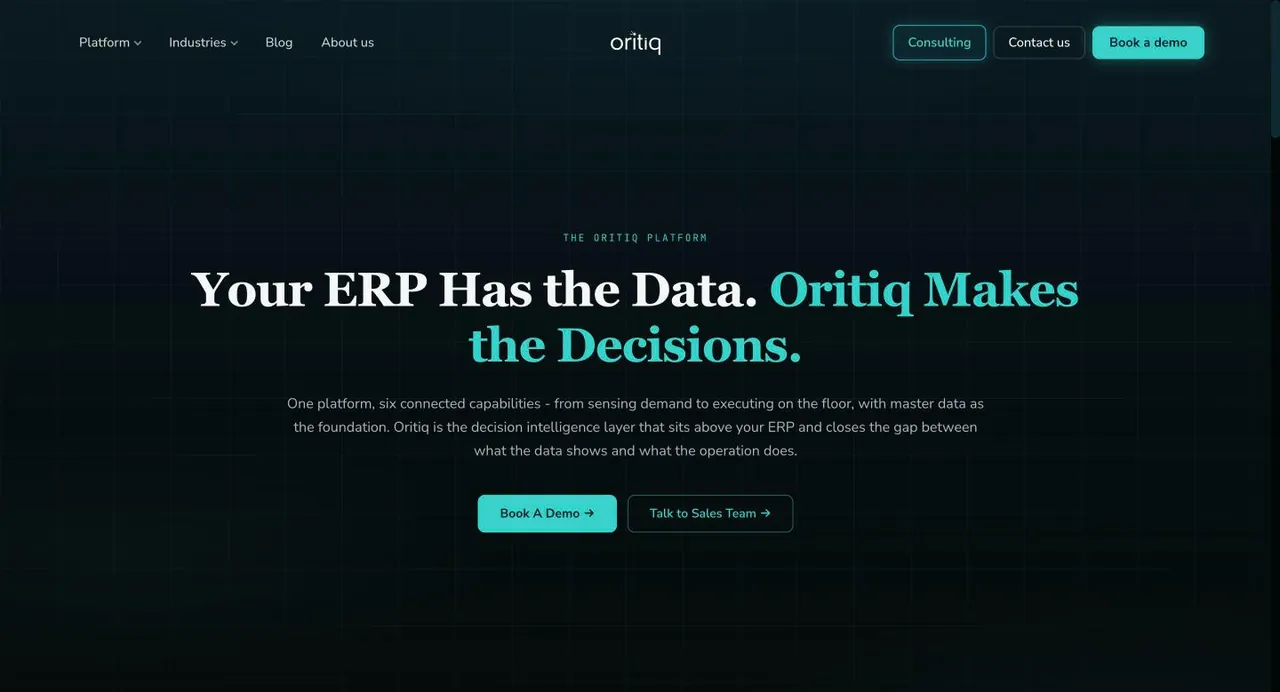
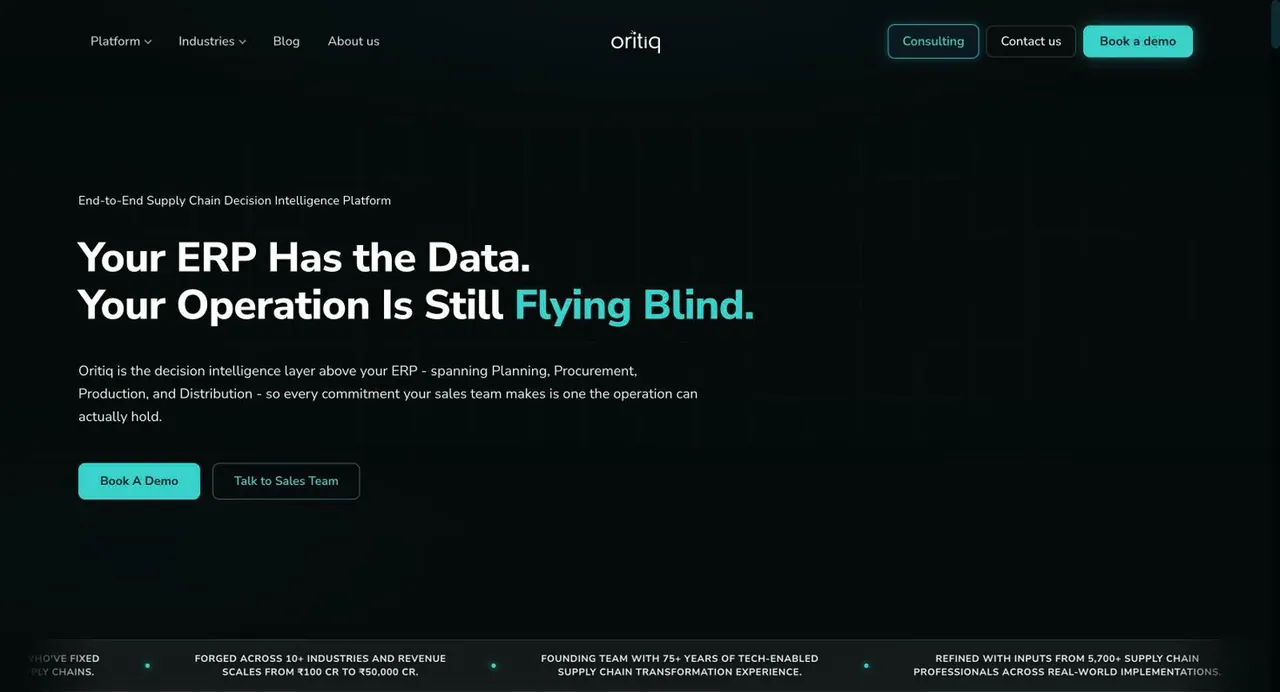
The homepage opens on 'Your ERP has the data. Your operation is still flying blind.' It names the buyer's existing investment in the first line and reframes it rather than attacking it. The product is then positioned precisely, as the decision intelligence layer above the ERP, spanning planning, procurement, production and distribution.
- Content
Write the symptoms in the buyer's own words
Instead of describing features, the site runs the questions operations leaders actually ask: why does my S&OP often fail, why does my master production schedule lose touch with reality within days, why does Excel-based planning fail on accountability and traceability, how do I handle supplier delays and their impact on production. A reader recognises their own month before they have learned a single product term.
- Content
Put the team's record where the hesitation happens
A running band of proof sits directly under the hero: 75+ years of supply chain transformation experience in the founding team, inputs from 5,700+ supply chain professionals, 100+ global supply chains fixed, 10+ industries. These answer the 'who are you' objection at the exact moment a cautious enterprise buyer forms it.
- UI/UX
Two ways in, because two people are reading
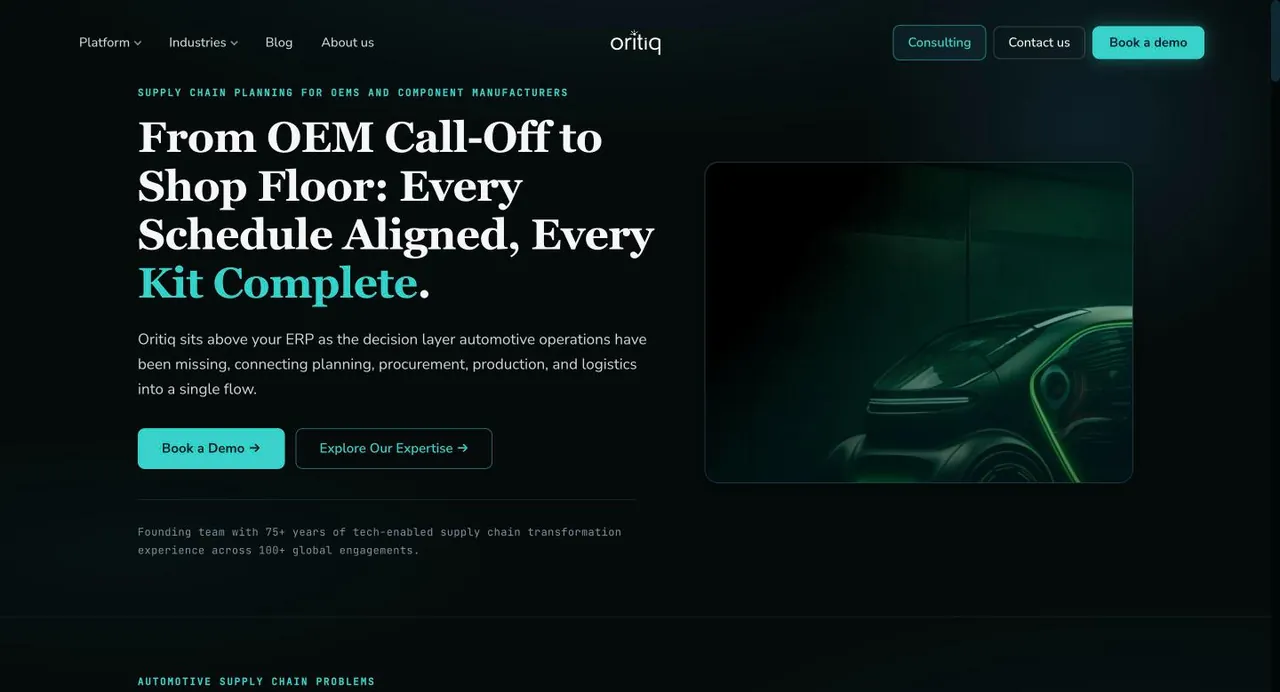
The platform navigation is organised by capability (demand forecasting, S&OP reconciliation, constraint-based supply planning, multi-echelon inventory optimisation, execution, master data management) and separately by industry. A planning head arrives by problem, a sector buyer arrives by their own industry, and neither has to translate.
- UI/UX
Two calls to action for two levels of readiness
Book a demo and talk to sales sit together throughout. Enterprise buying groups contain people ready to see the product and people who want a conversation first, and forcing both down one path loses the slower one.
Before and after
Drag to compare
Left is where they started. Right is where they are now.
Close your books in 2 days, not 12.
Ledgerly reconciles bank, cards and invoices automatically, so month-end stops eating your team.
Empowering Next-Gen Synergies With AI-Driven Innovation
We are a leading provider of cutting edge, best-in-class, end-to-end solutions for the enterprises of tomorrow, today.
The structural argument the site makes is worth stating plainly, because it is the whole sale: planning, execution and data sit in silos, and the monthly firefight is not a series of isolated failures but the predictable result of that separation. Once a reader accepts that framing, a decision layer above the ERP stops sounding like duplicate software and starts sounding like the missing piece.
Industry coverage is doing quiet qualification work too. Ten named sectors, each with its own page, tells a steel manufacturer that this is not generic software with a steel logo dropped on it. In enterprise manufacturing, that specificity is often the difference between a reply and silence.
From the project