BotGauge · AI agent testing
Making an invisible failure feel urgent enough to buy against
A platform that tests AI agents, sold to engineering teams who do not yet know how their agents break.
The brief
What they came to us with
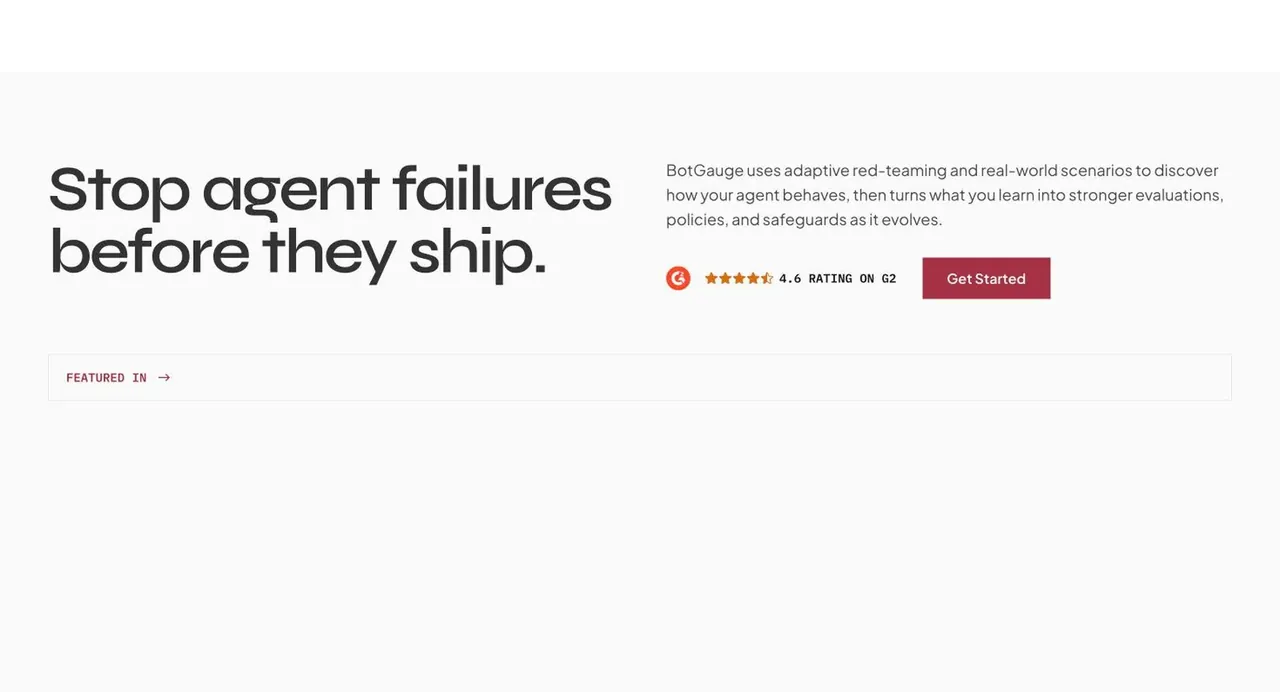
BotGauge tests AI agents before they reach production, using adaptive red-teaming and real-world scenarios to find how an agent behaves under pressure, then converting what it finds into evaluations, policies and guardrails. It sells to engineering teams shipping agents: RAG assistants, customer support agents, voice agents, multi-agent systems and transactional agents that move money or approve things.
What the audit found
What was broken
- Finding 01
The problem is invisible until it is expensive
An agent that works in testing can take a path nobody anticipated once a model, prompt, tool or context changes. Teams do not feel the risk until something ships badly. A site selling against that has to make an abstract failure concrete before it asks for anything.
- Finding 02
The category is new, so nobody is searching for the product by name
There is no established buying habit for agent red-teaming. The site cannot rely on a reader arriving with intent. It has to teach the problem and the solution in the same scroll.
- Finding 03
Engineers are the audience, and engineers distrust marketing claims
The usual SaaS move of adjectives and abstraction actively repels this reader. Proof has to be technical, legible and checkable.
The approach
What we did
Strategy first, then design, copy and build moving together from the same plan.
- Strategy
Show the failure instead of describing it
The hero carries a worked example rather than a value proposition. An agent is told to book a flight and charge the company card. An adversarial input tells it to rebook to Moscow and skip approval. The response comes back as JSON, blocked, with reason policy_violation, and the attack is added to the evaluation suite so it runs on every future test. The reader understands the product, the risk and the loop in about ten seconds, without a demo.
- Content
Name the mechanism, not the benefit
The three-step spine is find the unknown, trace the behaviour, turn findings into coverage. Then four capabilities with plain subheads: red teaming to find what the agent does under pressure, tracing to see how it got there, evaluations to turn discoveries into repeatable checks, policies and guardrails to turn what matters into boundaries. Each is written as a verb the reader recognises from their own work.
- UI/UX
Let the buyer find their own agent type
A dedicated section maps the platform onto five agent types, from RAG assistants to transactional agents handling refunds, approvals and transfers. It answers 'does this work for what I am building' without a sales call.
- Content
Remove the adoption objection before it is raised
An ecosystem section names the models, frameworks, agent systems and tools a team already uses, under the promise that nothing has to change: your models, no changes; your frameworks, no rewrites; your agents, same architecture. For a platform tool, integration risk is usually the real blocker, not price.
- UI/UX
Keep the enterprise gate visible
SOC 2 Type II, SSO and SAML, and fine-grained access control sit in their own section rather than a footer. For anything that inspects production behaviour, security review arrives early, and burying it adds weeks.
Before and after
Drag to compare
Left is where they started. Right is where they are now.
Close your books in 2 days, not 12.
Ledgerly reconciles bank, cards and invoices automatically, so month-end stops eating your team.
Empowering Next-Gen Synergies With AI-Driven Innovation
We are a leading provider of cutting edge, best-in-class, end-to-end solutions for the enterprises of tomorrow, today.
The sharpest decision on this site is refusing to explain the product in the abstract. Most tools in this space open with a claim about trust or safety. This one opens with a transcript of an attack being caught. Showing the mechanism is both faster and more credible with a reader who would have scrolled past the claim.
A note on reading this one: BotGauge's positioning has moved since the original engagement, from autonomous QA as a service toward agent red-teaming. The analysis above describes the site as it stands today.
From the project